Share This

Showing posts with label diabetes. Show all posts

Wednesday, July 15, 2026

Here's how to dine on durian wisely

 It’s hard to stop at just a few pieces of durian, but if you keep going, it can easily add up to another entire meal’s worth of calories. — LIM BENG TATT/The Star 

Two durian pieces fine, 15 equal to a meal, says dietitian

When durian season arrives, many Malaysians do not eat durian like fruit, they consume it like a feast.

If six apples were placed on the table, most people would not finish all six at one sitting.

The same goes for eight oranges or 10 bananas, for example.

But when it comes to durian, “just one more piece” can easily become 10, 15, or even 20 pieces (or seeds), before anyone realises it.

The issue is not that durian is “bad”. The real issue is portion size.

After 15 pieces

A recent personal observation using a continuous glucose monitor (CGM) showed how much portion size can matter.

A CGM is a small sensor that tracks glucose levels throughout the day.

Before eating the durian, the glucose reading was 4.9 mmol/L.

After consuming 15 pieces of durian, the reading rose to 8.0 mmol/L within an hour.

It peaked at 9.1 mmol/L after about 90 minutes before gradually coming down over the next few hours.

If blood glucose had only been checked before eating and two hours after eating, the result may not have looked alarming.

But the CGM showed the full journey: how high the glucose climbed, how long it stayed elevated, and how much work the body had to do to bring it back down.

This was only an individual observation, not a clinical study, and glucose response can differ from person to person.

However, it is a useful reminder that blood glucose response is not only about the type of food we eat, but also about the total portion we consume.

The glucose did not rise because of one piece; every extra piece contributed to the total glucose load the body had to manage.

Each piece of durian adds more carbohydrate for the body to process.

The body then releases insulin to help move glucose from the bloodstream into the muscles and liver to be used or stored as energy.

When calorie intake repeatedly exceeds what the body needs, the excess energy may contribute to weight gain over time.

Every additional piece means more glucose to manage, more insulin to release and more calories to handle.

Durian nutrients

An average piece of durian, weighing about 27g, contains approximately 45 kcal and 8g of carbohydrate.

At the same time, durian also provides dietary fibre, potassium, vitamins B and C, and beneficial antioxidants.

In other words, durian is still a fruit that provides good nutrients.

Like every other fruit, it has a recommended serving size.

Malaysians are generally encouraged to consume two servings of fruit daily, and durian can fit into this recommendation when eaten in the right portion.

For example, one serving of fruit looks like this:

  • One medium apple
  • One small banana
  • One medium orange
  • One slice of papaya
  • Two average-sized pieces of durian.

Two average-sized pieces of durian provide about 90 kcal and 16g of carbohydrates.

This can still be considered a moderate-sized snack portion.

That is why two average-sized pieces of durian can be considered one serving of fruit.

‘Just one more piece’
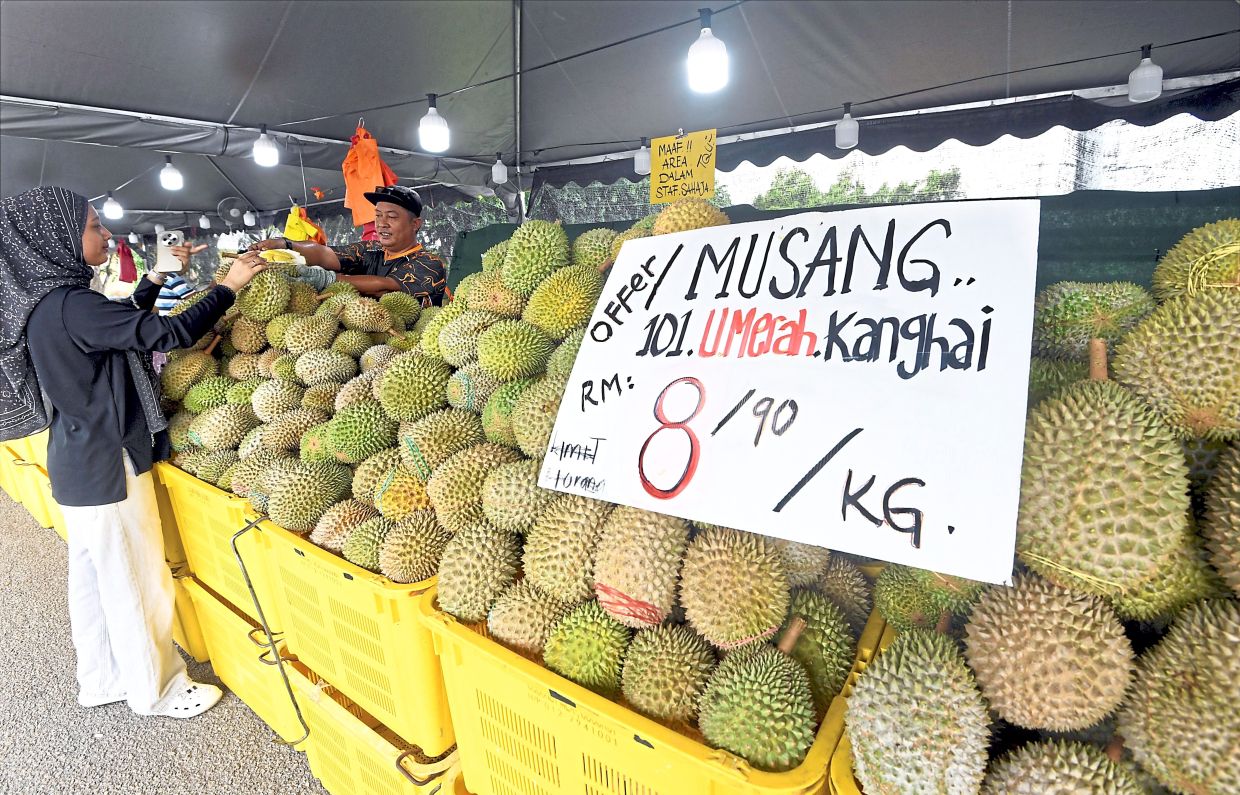
The current cheaper prices of durian makes it even harder to limit consumption for durian lovers. — AZHAR MAHFOF/The Star

The problem is not consuming the two pieces of durian; the problem is that durian is rarely limited to just two pieces.

Below are the amount of calories and carbohydrates for different amounts of durian:

  • One piece: 45 kcal and 8g
  • Five pieces: 225 kcal and 40g
  • 10 pieces: 450 kcal and 80g
  • 15 pieces: 675 kcal and 120g.

For comparison, a typical Malaysian lunch or dinner may provide around 500 kcal and 60g of carbohydrate, depending on food choices and portion size.

Now, imagine enjoying 10, or even 15, pieces of durian.

Without realising it, those “just one more piece” moments can quietly add another entire meal’s worth of calories and carbohydrates to your daily food intake.

Durian is generally considered a low to medium glycaemic index (GI) fruit.

Because of this, some people may assume it can be eaten freely.

ALSO READ: Understanding the glycaemic index

However, the glycaemic index of a food is only one part of the picture.

The bigger concern during durian season is glycaemic load, which refers to the total amount of carbohydrates consumed.

One or two pieces may be manageable for many people.

But 10 or 15 pieces create a much higher glucose load for the body to manage.

This is especially important for people living with diabetes, prediabetes, insulin resistance, weight concerns or a family history of diabetes.

Eat wisely

Still, Malaysians do not need to avoid durian completely.

Food should not be about fear; durian can still be enjoyed.

The key is to enjoy it with better awareness and a more mindful portion, especially when it is eaten after a full meal:

  • Keep to about two average- sized pieces as one fruit serving.
  • Avoid eating a large amount of durian immediately after a heavy rice-based meal.
  • Share with family or friends instead of finishing one box or fruit alone.
  • Eat slowly and enjoy the taste, instead of turning it into a challenge.

For people with diabetes, prediabetes or other health concerns, monitoring your blood glucose response and seeking personalised advice from a dietitian or healthcare professional can help support better food choices.

Durian season is something many Malaysians look forward to.

The goal is not to stop people from enjoying durian, but to help everyone enjoy it with better awareness.

Khoo Wei Jin is a dietitian at Alpro Pharmacy. For more information, email starhealth@thestar.com.my. The information provided is for educational and communication purposes only, and should not be considered as medical advice. The Star does not give any warranty on accuracy, completeness, functionality, usefulness or other assurances as to the content appearing in this article. The Star disclaims all responsibility for any losses, damage to property or personal injury suffered directly or indirectly from reliance on such information.

Related stories:


Two durian pieces fine, 15 equal to a meal, says dietitian 

Friday, June 27, 2025

Go easy on durian, say experts ; Time ripe to grow durian dynasty


(From left) Mohammad Taufik Saidon, Muhamad Hafiz Azizan and Mohd Iszuan Ismail from Alor Setar enjoying the King of Fruits at Anjung Indah in Balik Pulau, Penang. — ZHAFARAN NASIB/The Star

IT IS durian season again, but over-indulging in the King of Fruits can pose a serious risk to our health.

Universiti Sains Malaysia (USM) family medicine specialist Dr Mastura Mohd Sopian said those with diabetes, heart disease, kidney problems or high blood pressure should not binge eat.

“To enjoy the nutritional benefits of durian safely, limit intake to no more than two medium-sized pieces per day, or about 80g,” she said.

Eating too much durian could have a negative impact on blood sugar levels, she noted.

“Bingeing on durian may cause discomfort and disrupt normal metabolic functions.

“For those with chronic conditions, durian should only be consumed in small amounts, occasionally or not at all,” she added.

Dr Mastura said certain foods should be avoided when eating durian, which contains carbohydrates, vitamins and minerals.

“These include spicy dishes, caffeine, carbonated drinks, sweet fruits, desserts, soft drinks and sugar-sweetened beverages.

“Consuming these alongside durian can cause digestive discomfort and increase health risks,” she said.

“Durian also has a ‘heaty’ effect, though reactions may vary among individuals,” said Dr Mastura.

Penang Health Department nutritionist Zuhaida Harun said that like any other fruit, durian should be eaten according to the recommended serving size.

“One serving of durian is two to three pieces.

“It is high in calories and natural sugar.

“For people with diabetes, it can cause a dangerous spike in blood sugar,” she said.

Zuhaida said high consumption of durian could significantly increase a person’s overall calorie intake.

“Sometimes, bingeing can also lead to other health issues such as bloating, indigestion or feeling overheated,” she said, adding that moderation applied to all foods.

Penang health committee chairman Daniel Gooi reminded the public to practise moderation when enjoying durian, especially during the current peak season, to avoid potential health risks.

“Overindulgence, particularly in hot weather, can lead to discomfort such as a sore throat, dehydration or digestive problems,” he said.

“Drink plenty of water and exercise self-control to fully appreciate the fruit without experiencing adverse effects,” Gooi advised.

Source link

Time ripe to grow durian dynasty

Smells like success: Durians on display at a stall in SS2, Petaling Jaya. — ART CHEN/The Star

PETALING JAYA: In the world of durians, Malaysia’s Musang King may reign supreme but a new wave of contenders is emerging.

From the creamy Black Thorn and Red Prawn to the sweet Hajah Hasmah, the government is championing lesser-known premium varieties to capture growing international demand.

Other established types like Sultan and Tekka are also seeing interest, offering the fruit at a more accessible price and broadening Malaysia’s footprint in the global durian market.

Agriculture Department director-­general Datuk Nor Sam Alwi said Musang King and Bukit Merah are the main varieties recommended for export due to their rich, creamy texture and strong flavour but efforts are under way to highlight other premium types such as Black Thorn, Red Prawn and Hajah Hasmah.

“These varieties are being evaluated for future certification and export readiness, based on their potential in terms of taste, texture, shelf life and suitability for long-distance shipping,” she told The Star.

Nor Sam said that Chinese nationals, in particular, are willing to pay premium prices for these varieties.

As such, she said the department is working towards registe­ring durian varieties grown in Malaysia, conduct agronomic assessments and ensure compliance with the phytosanitary requirements of importing countri

“This includes pest disinfestation methods such as vapour heat treatment, traceability systems and farm export certification schemes,” she said.

CLICK TO ENLARGECLICK TO ENLARGE

These efforts, she said, were in line with the department’s goal of diversifying Malaysia’s durian varieties in the global market, strengthening the competitiveness of the national durian industry and maximising its export value.

The Malaysian Agricultural Research and Development Institute (Mardi) has found that there is a growing appetite for a wider range of flavours among durian enthusiasts.

“Consumers are becoming more adventurous. They are seeking out unique taste profiles. We are also seeing renewed interest in older, established clones such as D24 and Tekka, which are more affordable and offer classic durian characteristics,” it said in a statement.

Mardi said regional favourites and specific kampung durians with distinctive traits are gaining popularity, too.

On the export front, Mardi said it is focusing on developing new hybrids for domestic and global markets.

Its MDUR series (a hybrid durian clone developed by Mardi), in particular, has shown promise.

“One of the main highlights is MDUR 88 (D190), a hybrid of D10 and D24.

“It is golden yellow, slightly sticky and creamy with a flavour that many compare favourably to Musang King.”

In view of its quality, Mardi said the Agriculture and Food Security Ministry is promoting MDUR 88 for export.

“MDUR 88 has recently been rebranded as ‘MARDI Super 88’ (MS88),” it said.

Mardi is also working on other hybrids, such as MDUR 78 (D188) and MDUR 79 (D189), which offer improved yields and greater resistance to diseases like root borers and stem canker.

The institute also highlighted its broader breeding initiatives, noting that its second hybridisation programme, launched in the late 1980s, involved crosses between 10 different varieties.

Several promising hybrids from this programme are now in the final stages of assessment and are expected to be introduced under the 13th Malaysia Plan.

Mardi’s third set of hybrids is undergoing evaluation and assessment.

The institute is optimistic about the potential of these new hybrids.

“While Musang King and Black Thorn continue to set the benchmark in terms of market presence and price, we believe that our own developed hybrids, particularly MDUR 88, have the characteristics and quality to compete in the international market,” it said.

Federal Agricultural Marketing Authority (Fama) director-general Abdul Rashid Bahri said that in addition to Musang King, premium varieties including D24, Black Thorn, IOI and D9 have been sent for assessments to ensure they meet phytosanitary and quality compliance for targeted export markets like China.

“Fama is also working to expand market access beyond China and Hong Kong to countries such as the United Kingdom, Canada, the United Arab Emirates, Australia and the Netherlands,” he said.

Abdul Rashid said that strategic initiatives include participation in trade fairs, digital marketplace partnerships, in-store promotions and collaborative awareness programmes with the Malaysian embassies.

“To strengthen Malaysia’s competitive edge and credibility in premium markets, the ministry is also enhancing the national branding of agricultural produce through Malaysia’s Best, a certification that assures quality and safety for both domestic and international standards,” he said.

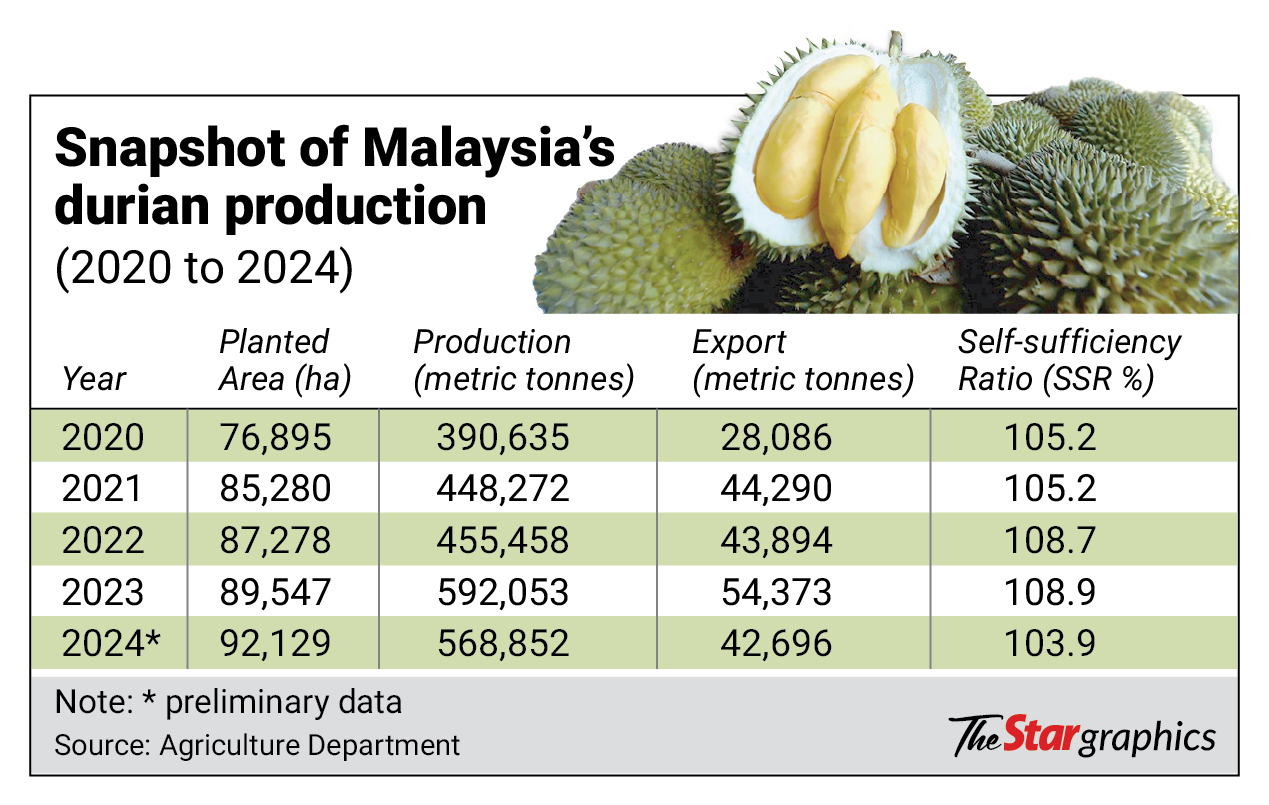
In 2023, Malaysia exported 54,374 tonnes of durians, valued at RM1.51bil, with China accounting for more than 45.7% of the total export.

Abdul Rashid said the volume is expected to increase following China’s approval for fresh durian imports.

“Fama will continue to work with industry stakeholders to monitor market trends, optimise logistics, and scale up capacity to meet growing international demand,” he said.

Malaysia’s durian cultivation area has been steadily expanding in recent years, with data from the Agriculture Department showing an increase from 70,286ha in 2019 to a projected 92,129ha in 2024.

Durian production followed suit, rising from 390,635 tonnes in 2020 to a projected 568,852 tonnes this year, despite some fluctuations due to weather and cost challenges.

The increase has been driven largely by global demand especially for premium varieties.

Related :

pike-

Spike-tacular search for best durian

9 Jun 2025 — Time ripe to grow durian dynasty · Roundup: Indonesian durian eyes China's massive market potential · QuickCheck: Is there really an odourless ..


6 Nov 2024 — From flower to ripe fruit, this takes about three months. This ends with the emergence of the beloved durian, a favorite among many. Durian ....
Kan Yao durians are available in Thailand during the wet season, typically from May through June. Current Facts. Kan Yao durians, botanically classified as