Share This

Tuesday, November 27, 2012

PAS messes up religion and politics again: Making one's hair stand!

  In a difficult position: Shoppers walking outside one of the unisex salons in KB Mall.

Datuk Takiyuddin Hassan's recent remarks about salons make us wonder if he has anything between the ears'. How then can he not know that PAS is messing things up in a respectable industry

DATUK Takiyuddin Hassan should be invited by hair stylists for a visit to their shops the Kelantan state executive councillor has no idea what he is talking about. To put it bluntly, he is talking rubbish.

He doesn't need to have a hair cut or a hair wash but simply observe the operations at a hair salon.

And sir, it is hair salon and not hair saloon. There is no drinking or entertainment of any kind.

A hair salon is different from a girlie barber shop, that's another point you should be aware of.

On Sunday, the PAS assistant secretary-general defended the PAS state government's decision to enforce gender-segregation rules on unisex salons, prohibiting women from cutting the hair of men, and vice-versa.

He said: “It is a well-known fact that hair salons and unisex establishments are the most convenient places for immoral activities.

“They provide a cover for men and women to engage in illicit activities. If I were a Chinese, I will never allow my wife to patronise such salons or even consider allowing my children to work in such places because of their reputation as a hotbed for immoral activities.

“And even a Chinese wife will feel uneasy to allow her husband to go to such places. Frequently such places will always lead to scandals.”

Like many Malaysians who read these remarks yesterday, I really didn't know whether to cry or to burst out laughing.

Many of us go to hair salons for hair cuts simply because, unlike barbers, these hair stylists are properly trained.

Many invested in diploma courses in famous training schools in London, Paris, Hong Kong and Bangkok.

We don't expect Takiyuddin to know what “a layer cut” is.

Huge sums of capital have been invested into their hair salons and many well-known hair stylists have turned entrepreneurs by setting up chains of hair salons nationwide.

These hair stylists work hard on their reputation, of which PAS may not be aware of, but clients are selective in their choice of hair salons.

Takiyuddin has no idea what he is talking about. We wouldn't blink an eye if our family members have their hair cut at hair salons - by a male or a female stylist.

And most of us have family members or friends who work at hair salons and we are proud of their skills and creativity. They make many Malaysians look good with their professionalism and abilities.

It is even more humorous when Takiyuddin said that “when a woman worker gives upper body massages to a male customer, one thing will eventually lead to another, ending with illicit activities”.

Hello, the nearest massage one gets at a hair salon is a neck-and-shoulder massage.

And from where Takiyuddin is coming from, he and his party leaders will surely shut down spas when they come to power.

Since male stylists cannot cut the hair of females and vice-versa, will we see PAS banning women doctors from treating male patients?

So if Takiyuddin suffers a heart attack while he is giving a press conference, will he wait for a male doctor to come, even if there is a female doctor nearby?

Next, women flight attendants won't be serving Takiyudidin when he is flying because it can lead to many things, what with their smiles and the uniforms they wear.

The hair on my hands are already standing on end just reading what Takiyuddin has reportedly said.
COMMENT By WONG CHUN WAI

Related Stories:
 Group expresses dismay over hair salon ruling
Hair-raising time for stylists and salon workers
Rising anxiety over implementation of hudud
Hairstylist moves to Johor to avoid ruling

Leading hairstylist slams ‘Jurassic’ rule

PETALING JAYA: One of the country’s leading hairstylists, Winnie Loo, has come out to defend the industry, saying that contrary to allegations by the Kelantan government, the business is run by professionals.

Don’t pay the summonses, salons told

PETALING JAYA: The MCA has advised hair salon operators affected by the Kota Baru Municipal Council by-law not to pay their summonses 

Takiyuddin's comments insult our intelligence - Opinion | 


Related posts:
Politics and religion just don’t mix 
Don't mess religion with politics!
Politics and religion a bad mix ! 

Politics, Religion don't mix! 

Malaysia is a Secular state or an Islamic country? 

Former Malaysian leaders were clear on Secularity of Constitution but their successors seem unclear!

How to make your hair stand up/ How to have troll hair! 

China now capable to deploy jets on aircraft carrier


Video: China conducts flight landing on aircraft carrier CCTV News - CNTV English

China has successfully conducted flight landing on its first aircraft carrier, the Liaoning, naval sources said.

A new J-15 fighter jet was used as part of the landing exercise.

After its delivery to the People's Liberation Army (PLA) Navy on Sept. 25, the aircraft carrier has undergone a series of sailing and technological tests, including the flight of the carrier-borne J-15.


Capabilities of the carrier platform and the J-15 have been tested, meeting all requirements and achieving good compatibility, the PLA Navy said.


Since the carrier entered service, the crew have completed more than 100 training and test programs.


The successful flight landing also marked the debut of the J-15 as China's first generation multi-purpose carrier-borne fighter jet, the PLA Navy said.

Designed by and made in China, the J-15 is able to carry multi-type anti-ship, air-to-air and air-to-ground missiles, as well as precision-guided bombs.


The J-15 has comprehensive capabilities comparable to those of the Russian Su-33 jet and the U.S. F-18, military experts estimated.


Successful aircraft landing exercises on China's first aircraft carrier mean the country is now capable to deploy fighter jets on the carrier, a senior navy officer said Sunday.


Pilots have mastered key skills to ensure the success of the take-off and the landing, especially under unfavorable conditions such as poor visibility and unstable airflow, said Vice-Admiral Zhang Yongyi, a deputy commander of the Chinese People's Liberation Army (PLA) Navy.


"It's like 'dancing on a knifepoint' as the aircraft have to land on a very limited space," Zhang said while commenting on the successful flight landing recently conducted on the carrier, the Liaoning.


The aircraft must land precisely over a very short and narrow runway on the carrier at a speed of several hundreds of kilometers per hour, Zhang said in an interview with Xinhua Sunday, after the J-15 fighter succeeded in the landing tests.


"We have done all these test flights from the very beginning, and finally we mastered the key skills for the landing of carrier-borne aircraft," said Zhang, who is also the commander-in-chief in charge of the tests and training program of the flight landing.


Currently, the Chinese pilots have found out the right ways to conduct the landing and they have consolidated their skills, according to the Navy officer, who himself is a meritorious pilot of the Chinese naval air force.


Zhang said the carrier-borne aircraft and special equipment for the landing flight have gone through strict tests, and fighter jets can be deployed on the aircraft carrier.

Monday, November 26, 2012

Penang's economy growth declines to 1.8% in 9 months 2012

GEORGE TOWN: Penang’s economy slowed down in the first nine months of the year, said Deputy Finance Minister Datuk Donald Lim.

“The state’s Gross Domestic Product (GDP) growth of about 5.7% in 2008 has dropped to 1.8% from January to September this year.

“The poor GDP record has put Penang, which used to record one of the highest growth rates in the country, in seventh position behind places like Kuala Lumpur and and Johor,” he said.

Lim said Johor recorded a GDP growth of more than 6%, exceeding the national average of 5.3%, adding that 1.8% was below average and the Chief Minister (Lim Guan Eng) had to answer for this.

“By right, Penang should be doing very well as many people are flocking to the state which has a service-skilled workforce.

“I’m surprised that Penang has done so poorly,” he said at the Malaysian Economy and 2013 Budget Economic Forum at a hotel here Saturday .

Asked why the Penang economy recorded such a slow growth, Lim quipped, “Probably he (the Chief Minister) didn’t work hard enough!”

“Perhaps his methods and direction are wrong or that he didn’t do enough homework. Maybe he is too busy with other things.

“I’m not saying that he’s not doing his job, this is for the rakyat to decide,” he said.

Lim added the Ministry of Finance was forecasting the last quarter of the year to record a GDP of about 5.2%.

He assured Malaysians that the country’s economy was not headed towards bankruptcy as speculated by certain quarters.

“We have a RM456bil debt as of last year but our revenue is RM881bil, and we incur a deficit of about 58.2%.

“Our economy is doing much better compared to our Asean counterparts such as Singapore which has a deficit of 107%. Even countries like the United States and those in European Union are suffering from a higher debt.

“Malaysia practices an open economic policy and as of Oct 15, our foreign reserve has reached RM424bil, making us the 19th biggest foreign reserve country in the world,” he said.

The forum, organised by the MCA Bukit Gelugor division, was attended by some 300 people comprising Barisan Nasional division leaders, community leaders and businessmen.

Also present were Penang MCA deputy chairman Datuk Dr Loh Hock Hun, Bukit Gelugor MCA division chairman Datuk Koay Kar Huah and Komtar Barisan co-ordinator Loh Chye Teik. - The Star

Related posts:
Malaysia's GDP growth dips to 5.2% in Q3, beats economists' forecast
US Fiscal Cliff poses threat to economy worldwide! 

Sunday, November 25, 2012

Good property management, maintenance add value

Stratified developments becoming a way of life
As stratified developments become a way a life, good maintenance and management have become an issue.
 
EARLIER this year, a new set of property managers replaced the previous one in the condominium that Siti lives. Not having a current account, she paid her quarterly management fees in cash. She was told that the receipt would be put in her postbox. It never came and she soon discovered that the property management company had absconded with the money.

As stratified developments which include condominiums, service apartments and gated and guarded projects become a way of life, good maintenance and management have become an issue.

Good management and maintenance will improve the value of the asset. This applies to all segments of the property market, be it residential, commercial or industrial.

Hence, the third reading of the Strata Management Bill 2012 on Monday is crucial, says Assoc-Prof Ting Kien Hwa, head of Centre for Real Estate Research at Universiti Teknologi Mara.

“Currently, property management is part of a service provided by valuers, who are regulated by the Board of Valuers, Appraisers and Estate Agents.

The work of valuers can be broadly divided into three areas property management, valuation work and real estate agency work.

This means that property management is a regulated profession and delinquents risk having their licence suspended.

For the last five to six years, managing stratified properties has become an issue, he says. As more of us live in gated and guarded developments, and high rise condominium and serviced apartments, property management is evolving to become a lucrative industry.

Ting says the Board of Valuers is in the process of creating a third register to accommodate property managers. Valuers and real estate agents are governed by two registers and the Board of Valuers are working on creating a third one for property managers.

Says Ting: “This is a similar situation as in the early 1980s when there were many illegal real estate agents. They were given a one-year period to register with the board.”

Ting says the duty and responsibilities of property managers go beyond just collecting money and managing a property. The word “managing” covers a whole gamut of expertise and responsibilities. These include insurance valuation, the appropriate rate of service charges to levy on owners, managing service providers like security guards and cleaners, gardeners and managing tenants and rental rates among other duties.

Depending on whether it is a residential or commercial property, some issues may overlap.

To claim that valuers want to monopolise the property management industry is incorrect, Ting says.

“Some parties say they want to liberalise' the profession. Just as engineers and architects are regulated by the Institute of Engineers and Pertubuhan Akitek Malaysia respectively, so property managers are regulated by the Board of Valuers because property management is part of the work of valuers. This is the situation in the United States, Britain and Australia. Shall we then liberalise' the achitecture and engineering profession by allowing more people who are untrained to practise as architects and engineers because architects and engineers are monopolising' the industry?” Ting asks.

Ting says this argument to liberalise the profession and cut out the monopoly does not hold water at all.

He says there are currently 8,000 trained property managers in the country and every year, 450 more graduates enter the job market.

The local public universities provided courses in property management in the late 1960s because they knew there would be a need for this.

Malaysian Institute of Professional Property Managers president Ishak Ismail says: “The Government was visionary enough to foresee a time when stratified housing will become part of the Malaysian property landscape. The first condominium was Desa Kuda Lari in the KLCC area.

“Today about four million people live in stratified projects. About 80% of all the stratified projects are managed by joint management bodies and management committees. About 20% are outsourced and of this about 58% are managed by illegal property managers.”

Ishak said over and above the various issues that fall under property management, two sets of skills are needed the hard skills in managing the property and the soft skills in people management.

He says there is a need to put in the proper regulations to regulate property managers in order to improve the value of our property assets. There must be no conflict of interest because it involves public money, be it house owners or tenants of commercial properties, he says.

By THEAN LEE CHENG The Star

Related post:
Is property building management a professional?

China courts friends in region; for others a show of strength

Chinese Premier Wen Jiabao (L) poses during the family photo at the 15th ASEAN-China summit meeting at the Peace Palace in Phnom Penh, November 19, 2012. Also in the picture is Cambodia's Prime Minister Hun Sen. REUTERS/ Samrang Pring

PHNOM PENH/BEIJING (Reuters) - When U.S. President Barack Obama and more than a dozen leaders arrived in Cambodia for a regional summit meeting this week, only one of them was feted with banners strung from the venue gates.

"Welcome Prime Minister Wen Jiabao!" one proclaimed. "Long live the People's Republic of China!" read another.

As the leaders left, the green-and-white banners were still festooned outside Phnom Penh's Peace Palace, a fitting reminder of China's powerful and growing clout as Beijing uses its influence - and money - to win friends and frustrate those uneasy about its sweeping territorial claims and rising military strength.

"Some states are easily swayed by money. If they see cash, they easily throw away their principles," said one Asian diplomat at the East Asia Summit, which included heads of state from 10 Southeast Asia countries and counterparts from the United States, China, Japan and other Asia-Pacific nations.

"China has been throwing its weight around and buying the loyalties of some Asian states."

A prime example is Cambodia, whose prime minister, Hun Sen, helped China to notch up a succession of diplomatic victories at the summit. China stalled debate on a resolution of maritime disputes in the South China Sea, rebutted attempts by Southeast Asian nations to start formal talks on the issue and avoided any rebuke from Obama over territorial ambitions. Commentators declared China a clear summit winner.

A closing statement by Hun Sen, this year's chair of the 10-member Association of Southeast Asian Nations (ASEAN), made no mention of the South China Sea, another victory for China's attempts to prevent multilateral talks on the dispute.

China has poured investments and loans into Cambodia in recent years, becoming its biggest trade partner and bilateral creditor. Cambodia's debt to China now totals at least $4.7 billion, about a third of its economy.

The price of that largesse has become clear this year, say analysts, as Cambodia has used its powers as ASEAN chair to restrict debate over the vexed issue of China's maritime claims, dividing the group and infuriating U.S. ally the Philippines.

The 45-year-old ASEAN group has been built on a foundation of unanimity and unity, but that has unravelled as it struggles to cope with its biggest security challenge. In July, a meeting of the region's foreign ministers broke down in unprecedented acrimony and failed to agree a communique for the first time.

This week's ASEAN meetings again deteriorated into bad-tempered sniping and came close to a breakdown when Hun Sen adopted a draft statement saying there was a consensus not to "internationalise" the South China Sea dispute beyond ASEAN and China.

The Philippines, which sees its alliance with the United States as a crucial check on China's claims at a time when Washington is shifting its military focus back to Asia, made a formal protest to Cambodia and succeeded in having that clause removed from the final statement.

China then poked fun at Manila's assertion that there had been no consensus. Eight out of 10 leaders had agreed not to internationalise the dispute, meaning there was a consensus, said Qin Gang, a Chinese foreign ministry spokesman.

"I suggest that people when attending the EAS (East Asia Summit) meetings have to be very good at mathematics," he said.

"That's 10 minus two, so which is bigger?"

NAVAL BUILDUP

Beijing claims a vast U-shaped line around the South China Sea that brushes up against the coasts of the Philippines, Vietnam, Brunei and Malaysia. The area is thought to hold vast, untapped reserves of oil and natural gas, and naval flashpoints between Chinese vessels and the Philippine and Vietnamese navy have become increasingly common.

Hopes for a diplomatic resolution within the ASEAN-China framework look bleak in the next two years as tiny Brunei and then Myanmar take up the chairmanship of the group.

Cambodia, like fellow "Mekong" countries Laos and Myanmar, has been rapidly pulled into China's economic orbit through rocketing trade and investment ties.

It has become customary for Chinese officials to arrive in Cambodia bearing "gifts", such as the $100 million investment that Wen announced on his arrival this week to build the emerging country's biggest cement plant. China has moved nimbly to set up free trade deals with Southeast Asia nations and has played a dominant role in financing and building big infrastructure projects in Laos, Cambodia, and Myanmar.

After the summit, Wen visited Thailand where he signed an understanding to buy rice, which should strongly lift Beijing's standing with a government that is a close ally of the United States. Bangkok has built up record stockpiles of 14 million tonnes of milled rice after a populist programme to pay farmers more for their crops made exports unprofitable.

If diplomatic efforts stall, China's options to back its claims with force if needed are steadily growing with a military budget that outstrips the combined spending of Southeast Asia.

As China ushered in a new generation of leaders this month, outgoing President Hu Jintao made a pointed reference to strengthening China's naval forces, protecting maritime interests, and the need to "win local war."

"We should make active planning for the use of military forces in peacetime, expand and intensify military preparedness, and enhance the capability to accomplish a wide range of military tasks, the most important of which is to win local war in an information age," Hu said.

Besides the South China Sea, China is embroiled in a dispute with Japan, also a close U.S. ally, over islands in the East China Sea.

China's stance is that it is not trying to become an offensive naval power, but wants to secure its energy imports and boost development of maritime natural resources, which are expected to represent 10 percent of its economy by 2015.

But it is also wary of being encircled as the United States refocuses its military clout on Asia in what Obama has called a "pivot" back to the region as wars in the Middle East wind down.

"It is absolutely (a buildup)," said Ruan Zongze, deputy director of the China Institute of International Studies, the think-tank of the Chinese Foreign Ministry.

"No matter what kind of narrative you use, the reality is that America in the past three years has been putting greater emphasis or focus on the west Pacific. That raises a lot of questions for China."

China launched its first aircraft carrier in September, increasing its ability to project forces deeper into "blue-water" maritime territory. Bought from Ukraine ostensibly to use as a floating casino, the Chinese navy spent years refurbishing the carrier, which is undergoing sea trials. It also test-flew two types of stealth fighters this year, the second one last month - a smaller, more maneuverable model believed to be designed to be deployed on an aircraft carrier.

"China has ambitions to become the premier military power among its regional peers, and a serious threat to U.S. maritime primacy in the Asia Pacific," said Sam Roggeveen, an Asian defence analyst with the Lowy Institute in Sydney.

Roggeveen added that if China were to deploy more than one carrier and equip them with high-performance stealth fighters, "it would become the pre-eminent regional maritime power, with the ability to coerce neighbours in disputes in which the U.S. prefers not to get involved".

 By Stuart Grudgings and Terril Yue Jones
(Additional reporting by James Pomfret and Manuel Mogato in PHNOM PENH; Editing by Jason Szep and Raju Gopalakrishnan)

Related posts:
ASEAN plans world’s largest trading bloc in Asia, the Regional Comprehensive Economy Partnership (RCEP) and the U.S. Secrecy in Trans-Pacific Partnership (TPP) 
What’s the intention of Obama’s visit to Asia?  
Asean nations feud over South China Sea

Saturday, November 24, 2012

ASEAN plans world’s largest trading bloc in Asia, the Regional Comprehensive Economy Partnership (RCEP) and the U.S. Secrecy in Trans-Pacific Partnership (TPP)

The leaders of Asean have succeeded in persuading their top trading partners to start negotiations on the Regional Comprehensive Economic Partnership (RCEP) to create the world’s largest trading bloc.

Cambodian Prime Minister Hun Sen formally launched the negotiations on the RCEP during the Asean Summit and Related Summits yesterday at a meeting at the Peace Palace in the western part of Phnom Penh.

The leaders of the 10-member regional grouping and their six major trading partners agreed to create a trading bloc that will comprise more than three billion people and with a combined GDP of US$15 trillion, roughly equal to that of the US.

Asean also launched the US-Asean Expanded Economic Engagement initiative, aimed at expanding trade and investment ties with the US and smoothing a path for the Trans-Pacific Partnership.

Trade Minister Gita Wirjawan said that plans for the RCEP would be welcomed by world leaders from Australia, India and the US as an amazing tool of economic integration that might become the benchmark for other regions.

“The spirit is not that of a zero-sum game. The economic integration of other regions is complementary to the economic integration among [Asean] member countries,” Wirjawan told The Jakarta Post on the sidelines of the event.

“Many Asean member nations are conducting bilateral talks that are just fine, because they are complementary [to the RCEP],” Wirjawan said.

The minister has previously said that the RCEP would “rewrap” five current free trade agreements (FTAs) with Asean’s six major trading partners, China, Japan, India, South Korea, Australia and New Zealand.

Asean’s FTA with Australia and New Zealand covers both nations.

Wirjawan said that the prospects for the RCEP were currently brighter than of the Trans-Pacific Partnership (TPP) free trade agreement touted by the US, as Asean already had FTAs in place, albeit mostly on goods and tariffs, with most of the nations involved.

The RCEP will expand upon existing FTAs to include agreements covering services and investment.

Asean is currently in discussions to expand its FTA with India, which it expects to complete in time for the Asean-India Commemorative Summit next month in India. Similar negotiations will follow with Japan.

Earlier in the day, there was a global dialogue between Asean leaders with the heads of world financial institutions, including Asia Development Bank President Haruhiko Kuroda, IMF Managing Director Christine Lagarde, World Bank Managing Director Caroline Anstey, UN Conference on Trade and Development Secretary-General Supachai Panitchpakdi and World Trade Organisation Director-General Pascal Lamy.

Wirjawan said that the leaders agreed that Asean had shown itself to be resilient amid the global financial crisis, becoming a model for other economic zones.

“Also discussed were efforts to face financial crises, such as the Chiang Mai Initiative pool of funds, which has been increased from $120 million to $240 million,” Wirjawan said.

Another important decision that was made during meetings and summits in Cambodia between November 15 and 20 was to start additional talks on implementing the Asean Economic Community on Dec. 31, 2015, to aid member nations in their preparations.

Asean’s leaders also adopted the Asean Human Rights Declaration, despite critics who said that the document was not up to universal standards of human rights protection, promotion, monitoring and enjoyment.

At the end of the closing ceremony, Hun Sen presented the gavel to Brunei Darussalam Sultan Hassanal Bolkiah to mark the handover of Asean’s rotating chair from Cambodia to Brunei starting on January 1.

Bolkiah said it would be the fourth time that Brunei would hold Asean’s chair, and that the nation had chosen a motto of “Our People, Our Future Together” for Asean for 2013.

Asean Secretary-General Surin Pitsuwan of Thailand also brought to an end to his term. He will be replaced by Vietnamese deputy foreign minister Le Luong Minh, who has been endorsed by Asean’s member nations.
___________________________________________

An alternative to US President Barack Obama’s Trans-Pacific Partnership, the 16-member Regional Comprehensive Partnership (RCEP) is the newest concept for an economic union between ASEAN and six major trading partners, China, Japan, India, South Korea, Australia and New Zealand.

The RCEP is supposed to be a trading bloc that will comprise more than three billion people with a combined GDP of $20 trillion, or almost one-third of the global economy. Officials hope to have the talks concluded by the end of 2015.

Source: Investvine
___________________________________________
Association of Southeast Asian Nations

The First ASEAN summit was held in February 1976 in Bali.

The most recent 21st Summit was held from November 18-20, 2012 in Phnom Penh, Cambodia
_______________________________________________
Video: ASEAN agenda


_______________________________________________
Video: Opening Ceremony of the 21st ASEAN Summit


______________________________________________

Trans-Pacific Partnership

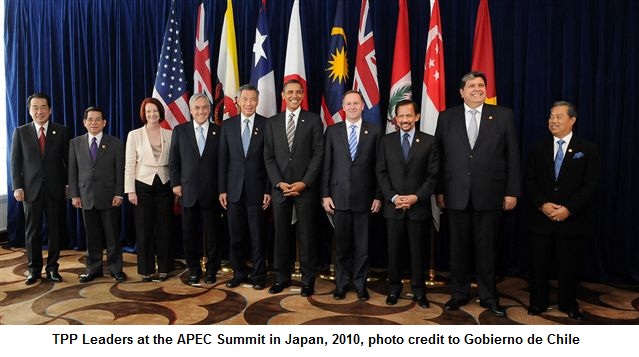
On November 12, 2011, the Leaders of the nine Trans-Pacific Partnership countries – Australia, Brunei Darussalam, Chile, Malaysia, New Zealand, Peru, Singapore, Vietnam, and the United States – announced the achievement of the broad outlines of an ambitious, 21st-century Trans-Pacific Partnership (TPP) agreement that will enhance trade and investment among the TPP partner countries, promote innovation, economic growth and development, and support the creation and retention of jobs.

INCREASING AMERICAN EXPORTS, SUPPORTING AMERICAN JOBS

President Obama announced in November 2009 the United States’ intention to participate in the Trans-Pacific Partnership (TPP) negotiations to conclude an ambitious, next-generation, Asia-Pacific trade agreement that reflects U.S. priorities and values. Through this agreement, we are seeking to boost U.S. economic growth and support the creation and retention of high-quality jobs at home by increasing American exports to a region that includes some of the world’s most robust economies and that represents more than 40 percent of global trade. The Obama Administration has been working in partnership with Congress and consulting closely with stakeholders around the country to ensure TPP addresses the issues that American businesses and workers are facing today, and may confront in the future.

The Trans-Pacific Partnership Framework

The United States, along with Australia, Brunei Darussalam, Chile, Malaysia, New Zealand, Peru, Singapore, and Vietnam are working to craft a high-standard agreement that addresses new and emerging trade issues and 21st-century challenges. The agreement will include:

• Core issues traditionally included in trade agreements, including industrial goods, agriculture, and textiles as well as rules on intellectual property, technical barriers to trade, labor, and environment.

• Cross-cutting issues not previously in trade agreements, such as making the regulatory systems of TPP countries more compatible so U.S. companies can operate more seamlessly in TPP markets, and helping innovative, job-creating small- and medium-sized enterprises participate more actively in international trade.

• New emerging trade issues such as addressing trade and investment in innovative products and services, including digital technologies, and ensuring state-owned enterprises compete fairly with private companies and do not distort competition in ways that put U.S. companies and workers at a disadvantage.

Leading Asia-Pacific Regional Integration Initiative

The TPP is the most credible pathway to broader Asia-Pacific regional economic integration. After nine rounds of negotiations, the nine countries made solid progress and have now achieved the broad outlines of an agreement. During their meeting on the margins of the APEC meeting in Honolulu, the TPP Leaders agreed to seek to conclude the agreement as quickly as possible and instructed their negotiators to expedite their work. The nine countries also welcomed the interest expressed by other countries in joining the agreement and will begin bilateral processes with these interested countries to discuss their readiness and ambition to meet the standards and objectives of the TPP. Once these bilateral processes have concluded, all current Parties will decide on inclusion of new members by consensus.

American Competitiveness in the Asia-Pacific

The TPP is a key element of the Obama Administration strategy to make U.S. engagement in the Asia-Pacific region a top priority. The huge and growing markets of the Asia-Pacific already are key destinations for U.S. manufactured goods, agricultural products, and services suppliers. As a group, TPP countries are the fourth largest goods and services export market of the United States. U.S. goods exports to the broader Asia-Pacific totaled $775 billion in 2010, a 25.5 percent increase over 2009 and equal to 61 percent of total U.S. goods exports to the world. U.S. exports of agricultural products to the region totaled $83 billion in 2010 and accounted for 72 percent of total U.S. agricultural exports to the world. U.S. private services exports totaled $177 billion in 2009 (latest data available), 37 percent of total U.S. private services exports to the world. America’s small- and medium-sized enterprises alone exported $171 billion to the Asia-Pacific in 2009 (latest data available).

_____________________________________________
Video: Trans-Pacific Partnership negotiated in secret


_____________________________________________
Video: Dennis Kucinich discusses the secrecy of the Trans Pacific Partnership
Dennis Kucinich (Democrat) is a member of the U.S. House of Representatives from Ohio’s 10th district
October 18, 2012 before the elction of the U.S. President took place on November 6, 2012


_____________________________________________

Sources: Novan Iman Santosa The Jakarta Post

Related post:
The US Pacific free trade deal that's anything but free? 
US launches financial attacks against its allies!

Schools to create 'Asian leaders' in Asian Century

This picture taken on July 23, 2012 shows 53 students from 14 countries holding hoops with their fingers as part of a cooperation learning exercise at a class of the International School of Asia, Karuizawa (ISAK) at Japan's mountain resort town Karuizawa in Nagano prefecture, central Japan. -- PHOTO: AFP 

KARUIZAWA, Japan (AFP) - Asia may be driving growth in the world economy but a Japanese businesswoman behind an innovative new school believes the region is over-reliant on Western-style leadership.

Lin Kobayashi believes Asia is over-reliant on Western-style leadership (AFP/File, Shingo Ito)

Ms Lin Kobayashi hopes her foundation outside Tokyo will help change that by breeding a wave of political and business leaders - but with what she sees as a more "Asian" way of thinking.

Building work on the International School of Asia, Karuizawa (ISAK) began in September. The launch of classes, all taught in English, is planned for 2014 making it Japan's first international boarding high school.

Ms Kobayashi, 38, a former investment analyst at Morgan Stanley, said the school will bring together students from a wide range of cultures and socio-economic backgrounds, with scholarships for poor students funded by donations.


Lin Kobayashi hopes her foundation will help to breed a wave of political and business leaders (AFP/File, Shingo Ito)

But she said she wasn’t aiming to simply rival elite schools such as  Britain’s Harrow or Dulwich College, which have set up Western-style campuses  in places such as China, Hong Kong and Thailand.

And she added she wanted to change what she sees as an assumption in Asia  that it was preferable to seek out education systems in which Western-style  leadership was taught.

“Asia is already at the centre of the world’s economy, but is still relying  on Western-style leadership that thinks charisma is only to be found in a loud,  top-down approach,” said Kobayashi, formerly of the Japan Bank for  International Cooperation and also the UN Children’s Fund in Manila.

“I think we need Asia-oriented leaders who value consensus and harmony and  can combine that with deep background knowledge about the complicated history  and diverse cultures of Asia.”

— Regional history —

The foundation has so far collected 1.5 billion yen ($19 million) in  donations and private funding to cover initial costs, while inviting prominent  business figures to come on board as advisors.

In July it opened its third annual 10-day summer school, with 53 students  from 14 countries. The course cost 300,000 yen.

Kobayashi said the school will place particular emphasis on regional  history, a subject that divides a continent where narratives differ widely from  country to country and are at the root of various territorial stand-offs.

Tensions have recently flared between Japan and China in a row over  disputed islands in the East China Sea, with trade between the two countries  looking set to suffer. The relationship was worth well in excess of $300  billion last year.

“We don’t teach one-sided history. It is important to learn about diversity  of historical perspectives and the multi-ethnic structure of the region,”  Kobayashi said, adding that she wanted to bring in teachers from many different  backgrounds.

Lzaw Saw Nai, a 14-year-old student from Myanmar who joined this year’s  summer school, said he was “very much interested in leadership”.

“We have political and many other problems in my country,” he said. “I feel  I should do something, but first I need to learn. So, I came here.”

Tareq Habash, 13, from Palestine, said: “My country is in need of leaders  who can understand the need of the country and not just for what they want for  themselves.”

— “Free-thinking” —

Kobayashi said she hopes potential future leaders of Japan, a place where  politics is often criticised for its lack of talent, will also benefit.

“Japanese education does not do enough to train people to lead,” she said,  adding that this was something the country desperately needed in a region  increasingly dominated by a rising China.

In the wake of defeat in World War II, Tokyo fashioned an education system  that prized uniformity.

While observers say this was one of the things that helped drive the  miracle of recovery, they also argue that uniformity is now hampering progress,  amid calls for strong, free-thinking leaders who can drive the country forward.

Yoshiaki Nomura, an expert in leadership education at Osaka University,  said the idea of the new Asian school was timely.

“I think a curriculum that will foster a new elite is needed,” said Nomura.

"We have learnt a lot about classic theories of Western leadership, but I often  feel that what we need in Asia may be different.”

Jun Nakahara, associate professor of higher education at the University of  Tokyo, agreed that leadership is not always an innate quality but rather “something you have to learn about”.

But he said on-the-job experience may be more valuable than classroom-based  learning.

“They have to provide students with opportunities for practical experience  in which they can exercise their own leadership,” he said.

He added that the school could be a ground for future networking  opportunities but that it would “take some time” before it enjoyed the kind of  influence of its established rivals in the West.

Sources: AFP/NST/Asia News Network

Friday, November 23, 2012

China's manufacturing growth quickens 13-month high

(Reuters) - China's vast manufacturing sector saw expansion accelerate in November for the first time in 13 months, preliminary results from a factory survey showed, a sign that the pace of economic growth has revived after seven consecutive quarters of slowdown.

The China HSBC Flash Manufacturing Purchasing Managers Index (PMI) rose to a 13-month high of 50.4 in November, the latest indicator of recovery in the real economy after data showing solid credit growth, firmer exports and rising industrial output in the previous month.

A sub-index measuring output rose to 51.3, also the highest since October 2011.

"This reflects that conditions for smaller firms, especially exporters, are looking up," said Li Wei, a Shanghai-based economist for Standard Chartered. "The consensus in the market is already for a small, gradual improvement."

An uptick in key economic activity indicators in October, following encouraging signs in September, cemented the view of many analysts and investors that a rebound in the world's second largest economy gathered momentum as it entered the fourth quarter, thanks to a raft of pro-growth policies rolled out by the government over recent months.

China is currently shuffling its senior officials after the seven top leaders of the ruling Communist Party were selected at a congress last week. The new appointments should end months of uncertainty in the highest ranks, although economic policy is not expected to change abruptly in the near-term.

Even before the congress, the central bank had moved to ease liquidity by pumping short-term cash into money markets rather than resorting to the interest rate cuts or reduction in banks' required reserve ratios that many investors had expected.

STEADY THROUGH YEAR-END

This month's PMI reading above 50 is likely to be seen as a turning point by the market, particularly if it is born out by the final reading due on December 1 and by official indicators.

Asian shares extended gains slightly after the data to stand up nearly 1 percent on the day and the Australian dollar, sensitive to demand from the biggest customer for Australia's resources, rose as far as $1.04.

"This confirms that the economic recovery continues to gain momentum towards the year-end," Qu Hongbin, chief China economist at index sponsor HSBC, said in a statement accompanying the data.

"However, it is still the early stage of recovery and global economic growth remains fragile. This calls for a continuation of policy easing to strengthen the recovery."

With a one-month exception in October 2011, the HSBC PMI -- which largely reflects the private manufacturing sector -- has remained stubbornly below the 50-point level separating accelerating from slowing growth since June 2011.

Unlike the patchy results seen in previous months, in November almost all the sub-indices in the HSBC survey concurred in showing an improving economy.

The one exception was a fall in the sub-index measuring output prices, demonstrating that manufacturers are still struggling with overcapacity and relatively weak domestic demand.

That could also reflect the weight in the survey of exporting firms, which have less ability to raise sales prices, said Standard Chartered's Li.

Indeed, China's exporters are increasingly squeezed by rising domestic costs and competition from new international suppliers, Zhou Haijiang, head of Chinese textile exporter Hodo Group, told reporters this month.

"Not only Western countries manufacture industrial goods, but also a lot of developing countries including former socialist countries who now have market economies are all exporting, thus creating a global surplus that cannot be changed," Zhou said.

"Because of this it is hard to raise sales prices, everyone is selling and it is hard for manufactured goods prices to rise. In some cases prices have even fallen."

Analysts expect no further cuts to interest rates this year or next after back-to-back cuts in June and July, and only one more 50 basis point cut to banks' required reserve ratios (RRR) in 2012 after three since late 2011 that have freed an estimated 1.2 trillion yuan for new lending.

Chinese banks are on course to make new loans worth more than 8.5 trillion yuan ($1.4 trillion) in 2012, expansionary versus the 7.5 trillion of new loans extended in 2011 and above the 8 trillion yuan that sources told Reuters back in February was the target for 2012.

Total social financing aggregate, a broad measure of liquidity in the economy, weakened to 1.29 trillion yuan in October, down from 1.65 trillion yuan in September, but still remained on track to hit a record 14 trillion yuan this year.

China also opened many previously-closed sectors to private investment with a view to funding new infrastructure projects and supporting economic growth without piling on more debt that local governments can ill-afford.

Although analysts expect fourth quarter GDP growth to outpace the 7.4 percent seen in the third quarter, full-year expansion for 2012 is expected to be the slowest in 13 years.

Thursday, November 22, 2012

What’s the intention of Obama’s visit to Asia?

From Nov. 18 to Nov. 20, U.S. President Barack Obama visited Thailand, Myanmar and Cambodia, and attended the 4th ASEAN-U.S. Leader’s Meeting and 7th East Asia Summit in Phnom Penh, Cambodia. It is his first diplomatic visit after the reelection, and he has become the first sitting U.S. president to visit Myanmar.

A woman takes a photo of a wall painting created by Myanmar graffiti artists to welcome President Obama in Yangon, Myanmar on Saturda(Photo: AP)

The three-day visit reflects Asian strategies of the Obama administration in the second term, which can be summarized into one focus, dual purposes and three pillars.

One focus refers to that Obama will promote the “rebalance” strategy in Asia during his second term. Southeast Asia is the focus of the Obama administration’s “rebalance” strategy. In other words, the U.S. will devote more political, economic, military, security and strategic resources to Southeast Asia in the course of shifting its strategic focus back to Asia Pacific.

Dual purposes mean that the United States, on the one hand, maintains dominance in Asia Pacific and, on the other hand, benefits from rapid economic development in Asia Pacific. The U.S. has for long been worried that the rise of emerging powers like China will squeeze its strategic room in Asia Pacific, its allies in the region might be alienated and it might be excluded from economic integration of Asia Pacific. Obama’s visit to Asia is designed to achieve the dual purposes mentioned above.


Three pillars are strengthening existing alliance, expanding new partnership and benefiting from the multilateral mechanisms. In Thailand, Obama highlighted the significance of traditional allies. Under the disguise of democracy, human rights and freedom, Obama tried to develop new partnership to expand the U.S. presence and influence on Southeast Asia in Myanmar. To achieve the end, the U.S. phased out political, military and economic sanctions against Myanmar, and claimed to provide an aid of 170 million U.S. dollars. In Cambodia, the U.S. attended the East Asia Summit, 4th ASEAN-U.S. Leader’s Meeting and Trans-Pacific Partnership Summit to secure a foothold in the Asian multilateral mechanisms.

Furthermore, the Obama administration is making slight adjustments to the “rebalance” strategy. He attached proper importance to economy and culture during his visit since the United States has received criticism for overplaying the military and security issues, as well as ill-disguised hostility against China.

The Obama administration is playing trick in the “rebalance” strategy. But, Man proposes, God disposes. The “God” refers to the regional and global trends. Those who bow before it survive and those who resist perish.

Read the Chinese version: 奥巴马亚洲之行的小九九, source: Jinghua Times, author: Jia Xiudong


Related posts:

Politics and religion just don’t mix


I READ “Keep faith out of politics” (Sunday Star, Nov 11; related post: Don't mess religion with politics!) with great interest. As you rightfully said “religion and politics, that’s a potent mix to be explosive”.

My name is Joseph Sta Maria, 50, and I am a member of the Portuguese community in Malacca. Having once been involved in politics, I can understand how dangerous it is for religion and politics to be mixed.

But sadly, many leaders of the Roman Catholic Church and churches from the various Protestant denominations seem to be getting carried away with their political beliefs and cloud this with their religious obligations.

While it is all right for them to support any political party as individuals even if the policies of the parties that they support go against the grain of their religious beliefs, preaching politics from the pulpit instead of spreading the word of God is a gross perversion and can be the biggest sin they are committing.

I am deeply saddened that the Church has been dragged into the political debate in the country.

The Church must always remain apolitical and priests and pastors must confine themselves to preaching the gospel and help provide spiritual guidance to their flock.

What we are seeing instead are sermons slanted towards one side of the political divide and the spreading of political hate against the other.

There appears to be blatant support to political leaders of questionable morality or a tendency to “close one eye” when it comes to their misdeeds and political shenanigans.

I can proudly say that my ancestors brought the Catholic faith to this part of the world, particularly to Malacca, in the 15th century from which it spread to the region.

As such, I feel I am qualified to give an opinion of the present position of some of the Catholic churches.

As custodians of the Catholic faith, the Malacca Portuguese community will take the lead in urging all Catholic churches to stop allowing politicians from using the premises and its congregation as a means of wooing votes for the next general election.

It is sad that some church grounds are been used by irresponsible people to spew partisan hate to the congregation.

As Catholics, we should never have allowed this to happen.

As for the leaders of the church, they must be made aware that they are taking a big risk by throwing their support behind any political party.

As you pointed out, politics and religion must never be mixed especially in Malaysia where religion is a matter, which can raise sentiments to boiling point.

If anything goes wrong, the Malacca Portuguese community will hold these errant leaders of the church responsible.

As the adviser of the Malacca Portuguese village community, I wish to remind all churches to be mindful of the possible consequences and the irreparable damage to the religious harmony that we have been enjoying all these decades.

I reiterate that the Church is a house of worship and it must never be allowed to be misused by politicians whether they are from the BN or the Opposition for the repercussions would be very serious.

I believe there are many people like me who object strongly to churches being used by politicians but are too afraid or just don’t want to raise their objection to their pastors and church leaders knowing that their objections will be shot down.

I urge all those who agree with me to come out loudly and clearly to do justice for their religion and their belief.

This paragraph from the Bible, Mark 12:17 clearly shows Christians the difference between politics and religion: Then Jesus said to them: “Give to Caesar what is Caesar’s and to God what is God’s.” And they were amazed at him.

JOSEPH STA MARIA Malacca

Related posts:
Don't mess religion with politics!

Politics and religion a bad mix ! 

Politics, Religion don't mix! 

Malaysia is a Secular state or an Islamic country? 

Former Malaysian leaders were clear on Secularity of Constitution but their successors seem unclear! 

Malaysia a transit point for terrorists or a terrorist recruitment centre? 

Wednesday, November 21, 2012

US Fiscal Cliff poses threat to economy worldwide!

Falling off the fiscal cliff would have a global economic impact, analysts say

The so-called "fiscal cliff" has been on the horizon for two years, but now the 31 December deadline is almost here.

Now that the presidential election is over it is hoped that policymakers will knuckle down to find a solution.


US fiscal cliff may hamper Malaysian economy, says economist

KUALA LUMPUR: Malaysia could experience a slower economic growth of between 3% and 4% next year if the US fiscal cliff kicks in by next January, OCBC Bank Bhd's economist Gundy Cahyadi (pic) said.

“It's going to create a huge impact if this were to happen. The fiscal cliff will create a recession in the US where its economy will likely contract by 0.5% and this may lead to a bigger than expected recession in the eurozone. The spill over effects may lead to global trade falling quite significantly.

“On the whole, we expect a growth of between 3% and 4% for next year,'' he said at a press briefing on OCBC's regional and global economic outlook for 2013. Fiscal cliff involves the simultaneous move to increase tax and spending cuts to reduce budget deficit.

He said on the whole OCBC was projecting the country's gross domestic product (GDP) for next year to be at 5.2% year-on-year, adding that at this juncture, the risk posed by the fiscal cliff was expected to be limited as the US government might finalise a new deal.

Gundy said the economic growth would be supported by Malaysia's investment growth, which was more than 20% for the first three quarters of this year, and strong positive momentum in private consumption growth.

However, he added the 20% investment growth would not recur next year but it would still expand by close to double digit, at least in the first half of 2013 as the Government was expected to continue ramping up infrastructure overhaul currently in progress.

The main risk to the bank's projection he said was the possible slump of global demand, especially as exports remained a main drag to Malaysia's growth in 2012.

External demand had continued to be a large drag on the country's economy, he said, noting that in terms of nominal value and its contribution to GDP growth, net exports were at a record low in the third quarter of this year.

Exports growth had been sluggish throughout the year, he said partly on the back of commodity price correction, and falling exports earnings would not only affect growth directly but would have negative spillover effects to households' spending behaviour.

There may be further pressure from the recent slump in crude palm oil prices which could be quite detrimental given the commodity boom seen in the past several years had led to a spike in investment in palm oil related industries, Gundy added.

On inflation, he said OCBC expected it to trend higher next year to about 3% from the likelihood of below 2% this year.

BY DALJIT DHESI The Star/Asia News Network

Related


Tuesday, November 20, 2012

Asean nations feud over South China Sea

PHNOM PENH - Southeast Asian leaders feuded on Monday over how to handle tense maritime territorial disputes with China, overshadowing talks at a regional summit meant to strengthen trade and political ties.

The leaders of the 10-member Association of Southeast Asian Nations had hoped to present a united front on the South China Sea row as they host Chinese Premier Wen Jiabao and US President Barack Obama for annual talks.

But that effort broke down just before Southeast Asian leaders were scheduled to meet Wen, amid divisions between Chinese ally Cambodia and the Philippines.

Cambodia, this year's ASEAN chair, said on Sunday that Southeast Asian leaders had agreed not to "internationalise" the disputes and would confine negotiations to those between the bloc and China.

The apparent deal would have been a victory for China, which has long insisted that it should only negotiate directly with rival countries and that the Philippines should not seek support from the United States.

However Philippine President Benigno Aquino on Monday publicly rebuked Cambodian Prime Minister Hun Sen, telling his fellow leaders no such consensus had been reached and he would continue to speak out on the global stage.

"The Philippines... has the inherent right to defend its national interests when deemed necessary," Philippine Foreign Secretary Albert del Rosario told reporters, quoting Aquino's comments to his fellow leaders on Monday morning.

The feud echoed unprecedented infighting at an ASEAN foreign ministers' meeting in Phnom Penh in July, which ended for the first time in the bloc's 45-year history without a joint communique.

The Philippines and Vietnam had wanted the communique to make specific reference to their disputes with China. But Cambodia, the hosts of the talks and a close China ally, blocked the moves.

ASEAN members Vietnam, the Philippines, Malaysia and Brunei, as well as Taiwan, have claims to parts of the sea, which is home to some of the world's most important shipping lanes and believed to be rich in fossil fuels.

But China insists it has sovereign rights to virtually all of the sea.

Tensions have risen steadily over the past two years, with the Philippines and Vietnam accusing China of increasingly aggressive diplomatic tactics to stake its claims.

Temperatures could rise again later Monday when Obama arrives in Phnom Penh to join the East Asia Summit, a two-day event also involving the leaders of Japan, South Korea, India, New Zealand and Australia.

Obama has previously angered China, and emboldened the Philippines, by calling for the rival claimants to agree on a legally binding code of conduct to govern their actions over the sea.

Analysts said he would likely repeat that call in Phnom Penh, as well as make comments highlighting the importance of freedom of navigation in the sea.

ASEAN officials had said they would push Wen during their talks on Monday to quickly start high-level, formal negotiations on a code of conduct.

But Chinese foreign ministry spokesman Qin Gang insisted that China wanted to continue with the current arrangement of lower-level talks on the issue. "We already have good discussions with ASEAN," Qin said.

Even with the South China Sea row festering, countries involved in the East Asia Summit were expected to focus on ways to expand economic ties.

ASEAN nations are set to officially launch negotiations on Tuesday for an enormous free trade pact with China, Japan, India, South Korea, Australia and New Zealand.

And despite their own territorial rows, China, Japan and South Korea are likely to hold talks in Phnom Penh on Tuesday aimed at kickstarting three-way free trade negotiations, according to Qin. - AFP


China opposes 'internationalisation' of sea row


Phnom Penh (AFP) Nov 19, 2012 - Chinese Prime Minister Wen Jiabao told Southeast Asian leaders Monday that negotiations to end territorial disputes in the South China Sea should only be held between claimant countries.


Wen stressed Beijing's position during a summit with the 10-member Association of Southeast Asian Nations (ASEAN) in the Cambodian capital of Phnom Penh, Chinese foreign ministry spokesman Qin Gang told reporters.

Qin said Wen quoted from a 2002 deal reached between ASEAN and China in which they agreed to limit negotiations to "directly concerned" countries.

Wen said that among the principles under the 10-year-old declaration is to "oppose the internationalisation of the issue".
"So Premier Wen quoted the principles... enshrined in the declaration," according to Qin.

ASEAN members Vietnam, the Philippines, Malaysia and Brunei, as well as Taiwan, have claims to parts of the sea, which is also believed to be rich in fossil fuels.

But China insists it has sovereign rights to virtually all of the sea.

Tensions have risen steadily over the past two years, with the Philippines and Vietnam accusing China of increasingly aggressive diplomatic tactics to stake its claims.

The Philippines has consistently sought wider help, such as from close ally the United States, in dealing with its more powerful Asian neighbour on the South China Sea issue.

The controversy of "internationalisation" flared again in Phnom Penh this week with the Philippines insisting it should not have to confine its negotiations to just with China.

US President Barack Obama, who arrived in Phnom Penh on Monday night for an 18-nation East Asia Summit, was also expected to raise his concerns over the South China Sea, which would anger the Chinese but embolden the Philippines.

Related posts:
Asean, an arena of superpowers

Sunday, November 18, 2012

Australia, still an US's sheriff in the Asian Century?

Down Under and all over: Australia is still finding its place in the world, a work very much in progress.  

Reeking of Austro-centrism: The White Paper has been criticised for remaining centred on Australia’s own concerns and interests, with scant consideration for Asia. — AFP

TWO Sundays ago, Australian Prime Minister Julia Gillard released the White Paper “Australia in the Asian Century”. For many, it was a long-awaited document.

Australia’s history, polity and geography make for an odd mix. Anglophone settlers had to reconcile themselves with a strange terrain, unfamiliar Aboriginal people, isolation from mother country Britain, even conflict between allegiance to the British crown and incipient republicanism, and now a rising Asia.

White settlers “tamed” the land and established thriving outposts around the edges of the vast island. Asian immigration followed, driven by push-pull factors of a relatively undeveloped East Asia and a more developed Australia.

As the 20th century began, a racist White Australia Policy restricted non-white immigration while encouraging European settlement. It lasted half a century and took another quarter of a century to dismantle.

Meanwhile, the indigenous peoples suffered disproportionately lower levels of life expectancy, education, employment and higher imprisonment rates.

Then later in the 20th century, East Asian economies surged. Trade links with East Asia multiplied in number and volume.

The self-image of Australia, the largest country in Australasia, Oceania or the South Pacific, became more fraught. Its geography, history, politics and society were not characteristically Asian, yet it felt increasingly overwhelmed by a rising East Asia even as it experienced the prosperity.

When the Labour Party’s Paul Keating was prime minister in the 1990s, he “declared” Australia an Asian country. After he left office, he reversed that stand and admitted that Australia was not an Asian country.

John Howard of the conservative Liberal Party next became premier and distinctly identified Australia as a Western, US-led ally in the world. President George W. Bush affirmed that by saying Australia was not just Washington’s “deputy sheriff” but its sheriff.

Labour’s Kevin Rudd next became premier, and much was made of his fluency in Mandarin. This was to be an Asian Century of economic paramountcy, led by a rapidly rising China.

Interactions with Asia and Asians, parti­cularly in economics, continued and grew. But Australia remained firmly rooted in the US-led Western sphere with its geopolitical concerns.

This added to Canberra’s fuzzy regionalism and amorphous identity in relation to Asia. The more Asia grew in global stature and consideration, the more vexed Australia’s strategic relationship with it became.

Amid these rising stakes, a White Paper as an official declaration of intent assumes considerable significance. But the heightened expectations produced general disappointment instead: most of the White Paper’s 320 pages and nine chapters concerned Asia, but seen narrowly for Australia’s own interests.

Reception to the document within Australia was reportedly supportive, but criticism from various quarters was also evident. There was more agreement over the need for the White Paper for an insular Australia than with the contents of this particular White Paper.

The parliamentary opposition criticised it for being long on rhetoric but short on detailed directions. The business community found it redundant since it was already relating very much with Asia.

Evidently these business critics saw international relations only through the prism of their business deals. The social, cultural, strategic and other aspects of external relations typically escaped them.

The White Paper itself begins with a decent outline of an ascendant Asia, a vast continent with mounting prospects, growing middle classes and expanding markets combining to change Australia’s priorities and “strategic environment”. Where East Asia was once seen as the source of unwanted migrants, it is now regarded as the fount of fresh capital and trade orders.

Much of what follows is an Australia-centric diagnosis and prescription of what Australians should do to benefit from such an Asia.

That Australia itself is so moved by Asia’s rise testifies to the cross-border nature of such fortunes, yet the White Paper remains centred on Australia’s own concerns and interests, with scant consideration for Asia.

A commentary by the Australian-born veteran industrialist, technical consultant and academic Murray Hunter, who has spent a productive working life in Asia, is telling. Writing in Indonesia’s Jakarta Post newspaper, he wondered aloud whether the White Paper actually depicted Australia finding its way in the Asian Century or just getting lost in Asia.

He said the document “reeked of Austro-centrism”, one-way concerns to get what it wants from Asia, and “niggling China with its staunch loyalty to the US” even though “China saved Australia from a deep recession”.

Action spoke louder than words, he said, and “Australia needs the region more than the region needs Australia”. He said the country had to overcome its deep-set belief that its own cultural values were somehow universally accepted across the region.

Murray said “the White Paper is still haunted by Australia’s past”, with Asia “seen only as a means for Australian incomes” to rise. He found the document failed to provide the “vital key” of “accommodation of Asia to what Australia really has to offer” as an independent country “willing to put its lot with Asia and not with the US”.

A recent high-level bilateral forum organised by ISIS Malaysia in Kuala Lumpur examined several aspects of the White Paper. “Chatham House Rules” meant that speakers could not be quoted or identified, but several comments remained pertinent.

The White Paper was seen to omit, among other things, measures for building relations with Asean countries and Asean itself. Some questions were also raised.

It was then explained that the “US military base” in Darwin was more of a facility than a base, since it would host only a rotation of US troops rather than a permanent emplacement. Australia was said to respect China’s right to modernise its military, while feeling equally entitled to nurture its security with the US.

It was further explained that Australia’s role was originally to find ways to engage the US in the region. It was “in Australia’s DNA” to seek security from US involvement in the region.

In a brief exchange later with visiting Australian Foreign Minister Senator Bob Carr, I asked him how the White Paper positioned Australia differently from the past in its relations with Asia.

He said Australia now better understood that its economic future was dependent on Asia, adding that Malaysia’s development was an example of what a growing middle class in the region signified.

On how Australia could better partner with East Asian countries for mutual benefit, he pointed to good governance, a record of economic reform and an exchange programme with young Malaysian Muslims for better understanding.

Carr said Australia should seek its security in Asia but not from Asia, while accepting Asean centrality.

He alluded to Australia’s role in the peace agreement in the southern Philippines brokered by Malaysia.

When asked about policy fluctuations between the Liberal and Labour parties, he said that although Australia is seen as a country with a security relationship with the US, there was more that could be said of that. He added that a country was entitled to look after its own security with its own foreign relations (Australia with the US).

Then when asked how Australia’s foreign policy was changing in respect of Asia, Carr said the fact that he was here in Malaysia while Gillard was in Vietnam, and both of them were heading to Bali (for an Asean-convened meeting), said it all.

Behind The Headlines By Bunn Nagara